






 EARTH
 4
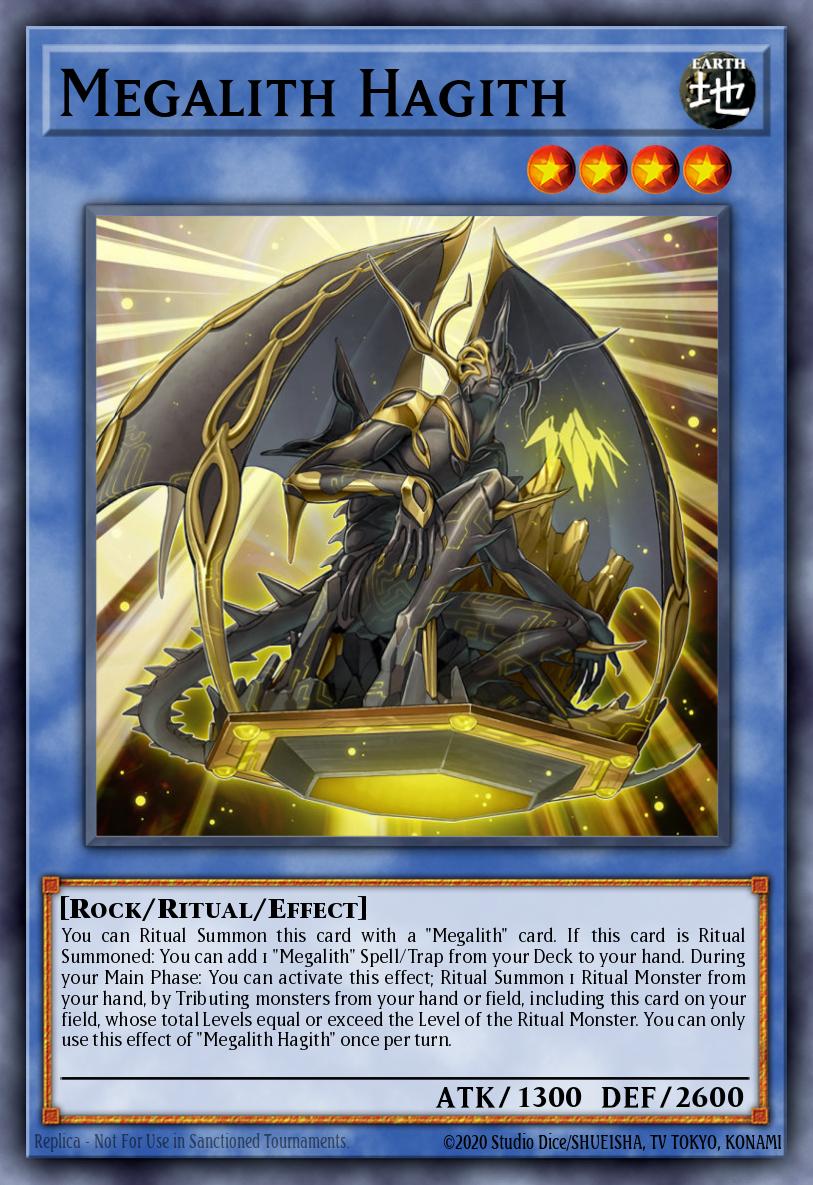
Megalith Hagith
Archetype:
Megalith
ATK:
1300
DEF:
2600
View:
4000
You can Ritual Summon this card with a "Megalith" card. If this card is Ritual Summoned: You can add 1 "Megalith" Spell/Trap from your Deck to your hand. During your Main Phase: You can activate this effect; Ritual Summon 1 Ritual Monster from your hand, by Tributing monsters from your hand or field, including this card on your field, whose total Levels equal or exceed the Level of the Ritual Monster. You can only use this effect of "Megalith Hagith" once per turn.
Megalith Hagith — Power Evaluation
Final Score: 69 ± 5 · Confidence: Medium
- Intrinsic: 66.38 · Deck: 70.46 · Meta: provisional
- Primary role: Extender · Secondary: Searcher/Tutor, Material body
Why it scores here
Megalith Hagith is a mid-turn ritual extender that tutors Megalith support cards on summon and enables a second ritual summon per turn. Its value derives from board expansion and consistency (tutor), not inherent disruption — negation and removal come from the secondary ritual monster (typically Bethor or Phul). High deck inclusion (51% in Megalith homes, average 2.21 copies) and portability across 40+ archetypes confirm strong accessibility and deckbuilding efficiency. The 1300 ATK and 2600 DEF do not drive the score; Hagith's power is ritual-chain enablement and consistency, limited by its HOPT and ritual-summon gate.
Axis scores
| Axis | Score | Evidence |
|---|---|---|
| Accessibility | 72 | Ritual-summoned via Megalith cards and searchable in ritual support lines; 51% of sample run Megalith (36.2% + 14.8%), with 167 of 400 decks running 3 copies. (Observed) |
| Combo & Conversion | 68 | Enables one second ritual summon per turn by tributing from hand or field; tutor adds a Megalith spell/trap. Board expansion depends on secondary ritual monster effects (inferred from Bethor/Phul partners at 98.2% and 96% co-deck rates). (Inferred) |
| Resource Economy | 60 | Tutor is a +1 on summon; ritual chain consumes materials but summons a second body, yielding resource-neutral play with modest consistency gain. (Verified) |
| Effect & Interaction | 18 | Hagith has zero disruption, negation, or removal; all opponent interaction comes from the secondary ritual summon. (Verified) |
| Material Utility | 65 | Level-4 EARTH Rock body is standard for ritual tributes and tributed as cost for the main-phase effect; 2600 DEF is high but rarely persists because the card is consumed. (Verified) |
| Resilience & Flexibility | 55 | HOPT on ritual-summon effect limits to one per turn; gated by ritual availability; body survives even if summon is negated, but effects are single-use. (Inferred) |
| Deck-Building Efficiency | 76 | 3-copy inclusion is typical (167 of 400 decks), with no bricks or self-locks reported; ritual-gated but not restrictive in ritual archetype decks. (Observed) |
Calculation
Weight profile: 0.7·Extender + 0.3·Searcher. Intrinsic ≈ 66.38, Deck ≈ 70.46, Meta = provisional. Modifiers: none. Final formula: 0.40·Intrinsic + 0.60·Deck
Strengths
- Enables consistent ritual-summon chains mid-turn, expanding board presence.
- Tutors Megalith spell/trap on summon, improving archetype consistency and hand quality.
- Highly portable across 40+ distinct archetypes (Megalith, Impcantation, Drytron, Dogmatika, Nekroz, Gem-Knights, etc.).
- No self-locking restrictions or garnet risk; 3-copy inclusion is standard and healthy.
- Level-4 body with high DEF (2600) is usable as ritual material even when negated.
Weaknesses
- Zero built-in disruption; board impact depends entirely on secondary ritual monsters.
- HOPT on the main-phase ritual-summon effect limits to one activation per turn.
- Ritual-summon gate requires archetype support (Megalith enablers, Impcantation, etc.); not live in all decks.
- Typically tributed as cost for the ritual chain, meaning it does not persist on-field.
- 1300 ATK is low; body is easily removed by common removal before summoning another ritual.
Counters / choke points
- Ash Blossom & Joyous Spring negates the tutor effect on ritual summon, whiffing the search.
- Hand traps that negate ritual summons prevent the Hagith summon entirely.
- Common removal (Kaiju, Droplet, Accesscode) targets Hagith before it tributes for the second ritual summon.
- Decks lacking ritual enablers (Bethor, Phul) cannot convert Hagith's mid-turn effect into meaningful board.
- Non-ritual decks or going-second strategies do not leverage this card's turn-1 extender role.
Best use
Turn-1 ritual-chain extender and consistency searcher; pairs with Bethor (negation) and Phul (removal/draw) for full disruptive boards.. Decks: Megalith (primary, 51% of sample), Impcantation (9.5%), Drytron, Nekroz, Gem-Knights. Suggested copies: 3.
Evidence & gaps
- Verified: Ritual summon gate: 'You can Ritual Summon this card with a Megalith card' (text); Tutor effect: 'If this card is Ritual Summoned: You can add 1 Megalith Spell/Trap from your Deck to your hand' (text); Mid-turn ritual-chain effect: 'During your Main Phase: You can activate this effect; Ritual Summon 1 Ritual Monster from your hand…including this card on your field' (text); HOPT on ritual effect: 'You can only use this effect of Megalith Hagith once per turn' (text); 3-copy inclusion: 167 of 400 decks run exactly 3 copies (deck distribution); 40+ distinct archetypes run this card (deck data); Top-partner co-deck rates: Bethor 98.2%, Phul 96%, Unformed 93.8% (deck partners)
- Observed: 51% of sample is Megalith archetype (36.2% + 14.8% split) (deck archetype data); 100% inclusion in Megalith (gameplay 7) and Megalith (gameplay 6) (usage statistics); Average 2.21 copies per deck, with modal count of 3 (deck distribution); High co-deck correlation with ritual-enabler cards suggests core role in ritual chains (deck partners)
- Inferred: Combo conversion ~68: enables one second ritual summon per turn; disruption depends on secondary ritual monster (inferred from Bethor/Phul partner prevalence and typical ritual-chain structure); Generic utility ~75: ritual-gated limits universality to ritual decks, but 40+ archetypes and high portability across ritual homes confirm strong portability (inferred from archetype breadth and ritual-support pattern); Deck synergy ~77.5: inferred from top-partner co-decks (Bethor 98.2%, Phul 96%) and archetype prevalence, indicating central role in ritual combos (inferred from deck data, no direct combo examples); Deck resilience ~75: multi-copy redundancy (167 at 3 copies) and presence in multiple ritual homes (40+ archetypes) suggest the role is resilient and replaceable within ritual structures (inferred from copies and archetype count)
- Data gaps: No combo data supplied — combo conversion, board-building power, and synergy are inferred from deck partners and archetype prevalence, not from observed combo boards. No banlist token or format legality details — assumed 3 copies (unlimited) in all formats. No metagame sample — cannot assess meta_power or recent tournament performance. Guides mention only Solo Mode rewards, not competitive strategy or role clarity; strategic context is inferred from card text and deck evidence alone.